
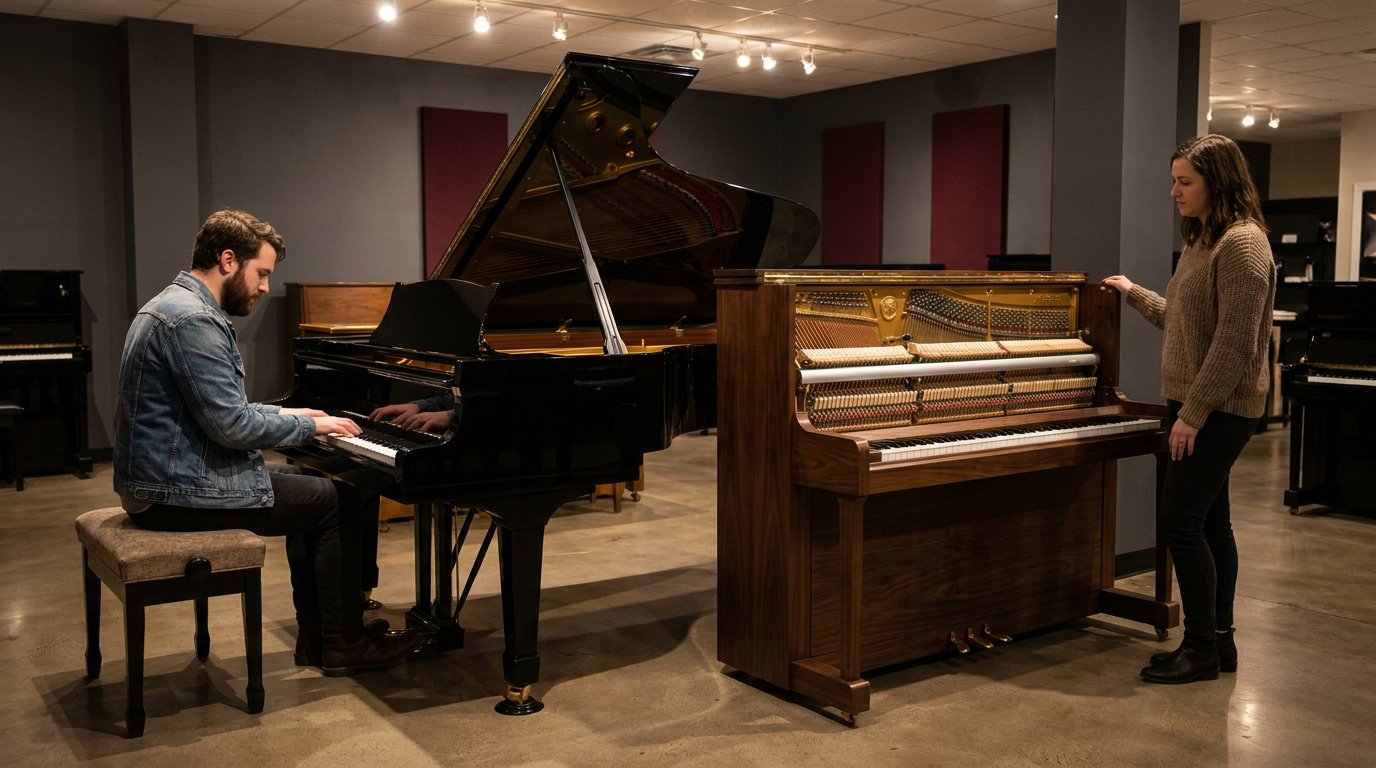
Grand or Upright Piano: When Is a Grand Worth the Choice
A grand piano isn’t automatically the better choice. The grand vs. upright piano decision comes down to what matters in your room and at the keyboard: a grand’s horizontal strings and action support a different playing response, while an upright’s vertical layout makes it a practical fit when floor space is limited. Choose a grand when its sound, feel, and larger footprint suit your musical needs and home; an upright may be the more sensible choice when they don’t.
Both types can be rewarding instruments, so it’s worth weighing more than appearance. This comparison explains how their actions and string arrangements shape playing and sound, then considers the room and musical priorities that may make a grand the better fit. Use it to decide which piano suits your practice, lessons, or home.
Key Takeaways
- Choose based on the space you have and the sound and musical expression you want, not appearance alone.
- Understand how each piano’s action affects note repetition and the feel of playing.
- See why the direction of the strings matters, while remembering that layout alone doesn’t determine an instrument’s sound.
- Use your playing needs, room, and priorities to decide whether a grand’s advantages make its larger footprint worthwhile.
Grand or Upright?
A grand’s horizontal design generally accommodates a larger soundboard and produces a fuller, louder tone. An upright’s vertical layout takes up less floor space, so room size and playing needs are central to the decision.
Grand piano considerations
Grand pianos typically have larger soundboards than uprights, which generally makes them louder and richer sounding. Their soundboards have a concave parabolic crown facing the strings. A baby grand may be about 5 feet long, with a footprint traditionally around 5 by 5 feet. Its sound and expression can suit players who want a broad, resonant tone and have room for the instrument.
Grand piano prices vary by instrument, while a used piano’s value depends on its condition, age, and demand. Lifespan also depends on condition and care. Before buying used, inspect the cabinet, keys, pedals, and strings, and listen for consistent sound across the keyboard.
Upright piano considerations
An upright places its strings vertically, with the soundboard generally smaller than a grand’s. That layout makes it a practical choice where floor area is limited, though its sound is generally less loud and rich. Modern uprights are around 132 centimeters tall; measure the intended space and allow room to sit comfortably at the keyboard.
New and used upright prices vary by instrument and condition. Durability and resale value also depend on care and age. When considering a used upright, inspect the keys, pedals, cabinet, and strings, then play notes across the keyboard to check for uneven sound or response.
Neither type has a fixed lifespan or maintenance cost. Condition, care, and use affect durability and upkeep, while tuning costs depend on the piano and the work required. These expenses are separate from the purchase price.
| Option | Sound and expression | Space | Used-piano checks |
|---|---|---|---|
| Grand | Typically louder, richer sound | Baby grand: about 5 feet long | Cabinet, keys, pedals, strings, and even notes |
| Upright | Generally less loud and rich | Modern models: around 132 centimeters tall | Cabinet, keys, pedals, strings, and even response |
Choose based on the sound you want, the space available, and the instrument’s condition.
How upright and grand piano actions work
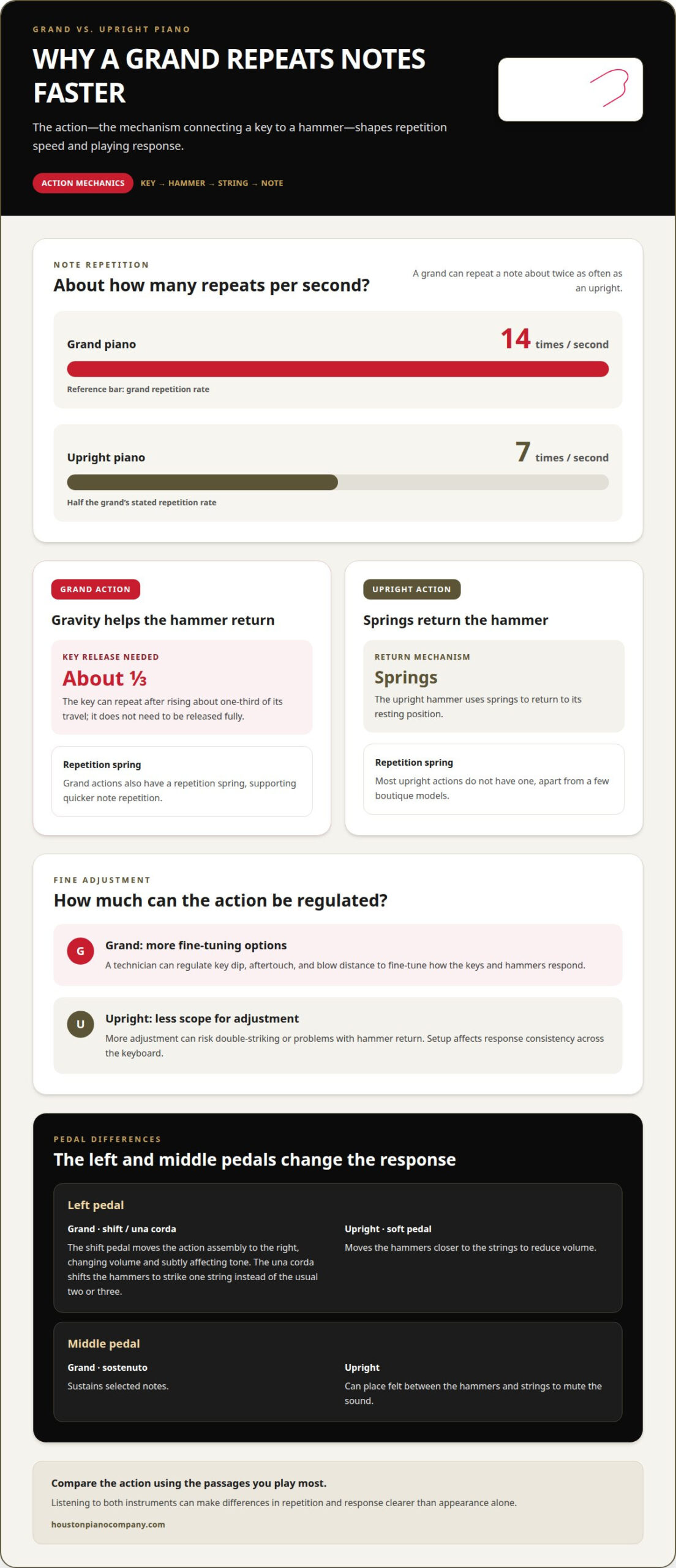
The action connects each key to a hammer, which strikes a string to produce a note. In a grand, gravity helps the hammer return to its resting position. An upright’s hammer uses springs to return. These different mechanisms affect how quickly a player can repeat notes, especially in fast passages.
A grand piano can repeat a note about 14 times per second; an upright can repeat one about seven times per second. A grand key can repeat after rising about one-third of its travel, so the player doesn’t need to release it fully. Grand actions also have a repetition spring. Most upright actions don’t, apart from a few boutique models, which contributes to the difference in repetition speed.
Adjustability is another difference. A grand action can be regulated for key dip, aftertouch, and blow distance, letting a technician fine-tune how the keys and hammers respond. Upright actions have less scope for adjustment without risking double-striking or problems with hammer return. The action’s setup affects how consistently the piano responds across the keyboard.
Pedals also affect how each action works. Pressing a grand’s left shift pedal moves the action assembly to the right, changing volume and subtly affecting tone. Its una corda pedal shifts the hammers so they strike one string instead of the usual two or three. On an upright, the left soft pedal moves the hammers closer to the strings to reduce volume. A grand’s middle sostenuto pedal sustains selected notes; an upright’s middle pedal can place felt between the hammers and strings to mute the sound.
When comparing a grand vs upright piano, listen to how each action responds to the passages you play most. Trying both can make the differences clearer than appearance alone.
Vertical versus horizontal string arrangement
A useful grand vs upright piano comparison starts with the direction of the strings. Their arrangement reflects how each piano is built, but does not by itself determine the sound of a particular instrument.
Vertical string arrangement
In an upright piano, the strings run vertically inside the cabinet. The strings and soundboard stand upright, rather than extending horizontally through a grand’s body. One cited upright has a lowest bass string measuring 36 inches. That example shows how string length can differ between individual instruments, even within the same piano type.
Horizontal string arrangement
Grand piano strings run horizontally through the instrument. One cited baby grand has a lowest bass string measuring 42 inches, compared with the upright’s 36-inch bass string. These examples illustrate how one baby grand can have a longer lowest bass string, though they don’t establish a rule for every model.
The grand vs upright piano distinction hasn’t always followed today’s familiar pattern. Both types were straight-strung before the early 20th century. In straight-strung pianos, strings run parallel rather than crossing over one another. This history shows why a piano’s exterior shape doesn’t reveal every detail of its string arrangement.
Erard continued making straight-strung concert grand pianos until the 1920s. This example shows that the construction method persisted even as piano designs changed. For a grand vs upright piano choice, consider the individual instrument’s string layout rather than assuming every piano in its category shares identical construction or string lengths. A vertical arrangement identifies an upright layout, while a horizontal arrangement is characteristic of a grand.
Hybrid pianos use a real grand piano action, but the hammers strike sensors rather than strings, and speakers produce the sound. The action is retained, while sensors replace strings as the sound source.
When a grand piano is worthwhile
A grand is worthwhile when its playing response, sound, and physical presence suit your musical plans and room. A baby grand may be about 5 feet long, while concert grands can range from 7 to 10 feet.
Either type can suit beginners and home practice; an upright often works well where space is limited. For professional performance, a grand’s responsive action and broad sound can support demanding repertoire, if the room has enough space. Beginners deciding among acoustic, digital, and portable options can also explore piano options for beginners.
Room measurements help make the choice concrete. Baby grands are traditionally about 5 by 5 feet, while a modern upright is around 132 centimeters tall. A mid-sized grand is typically around 7 feet long, while a full concert grand is about 9 feet long. Measure the intended floor area, including space to sit and move around the instrument, before settling on a grand.
Consider how you’ll play. Someone working on repeated notes and expressive passages may value a grand’s action and tonal range. A household focused on regular practice may prefer an upright’s smaller footprint. A grand’s larger sound can suit a spacious room, while its volume may feel less comfortable in a compact space.
Use these decision points:
- Room: Match the grand’s length and footprint to the available floor area.
- Playing: Choose the action and expression that support the repertoire and practice routine.
- Household: Consider how the instrument’s sound will fit everyday use.
A grand is not automatically the better piano; its advantages matter most when room and playing needs align. Explore grand piano options and consider how their size and response fit your home.
Houston Piano Company
Houston Piano Company offers new and used pianos to compare as you weigh a grand against an upright. Trying instruments in person makes differences in sound, touch, and scale easier to judge than measurements alone.
Consider the room where the piano will sit, how you plan to play, and which qualities matter most. Houston Piano Company offers STEINWAY and KAWAI pianos, alongside other new and used options, giving you choices to consider as you narrow your decision. A conversation can help connect your priorities with the kind of instrument you’re looking for.
Contact Houston Piano Company to talk through your piano choice.
Make the Choice That Fits Your Music
A piano becomes part of a home’s daily rhythm, so choose one that suits how you want to play and live with it. Picture the instrument in its intended place and consider the music you hope to make there. A grand may appeal if its presence and playing character inspire you; an upright may suit a room where floor space matters. The right choice is one you’ll enjoy returning to, practicing on, and sharing.
You don’t have to make the grand vs. upright piano decision from specifications alone. Take time to experience the touch and sound of different instruments, then notice which one makes you want to keep playing. Houston Piano Company offers Yamaha pianos to explore as you decide.
Contact Houston Piano Company to continue your search and find a piano that feels at home in your musical life.
Frequently Asked Questions
Who needs a grand piano?
A grand can suit players whose repertoire and musical goals call for its expressive range and who have room for its larger shape. It may also fit a household that regularly plays for guests or accompanies other musicians. Beginners don’t need to start with a grand, but a player who enjoys its feel and sound may choose one for home practice.
What are the main differences between a grand piano and an upright piano?
The main differences are string direction, action design, and footprint. These features affect how a piano responds and fits into a room. Look beyond the category: consider the individual instrument’s sound, touch, and condition, then weigh those qualities against your playing habits and available space.
How does the action mechanism affect a grand piano’s touch and responsiveness compared with an upright?
A grand action generally allows faster note repetition and more adjustment of the player’s response. This can help with repeated notes and delicate changes in touch. An upright’s action returns differently, so its repetition and feel may differ. Play a familiar phrase on both and notice which action feels easier to control.
How do grand and upright pianos compare in sound, volume, and tone?
Grand pianos typically have larger soundboards than uprights, generally contributing to a louder, richer sound. Still, judge an instrument’s tone in the room where it will be played. A sound that feels full in a large space may seem overwhelming in a smaller one. Try playing softly and strongly, and listen for the tone that suits your home.